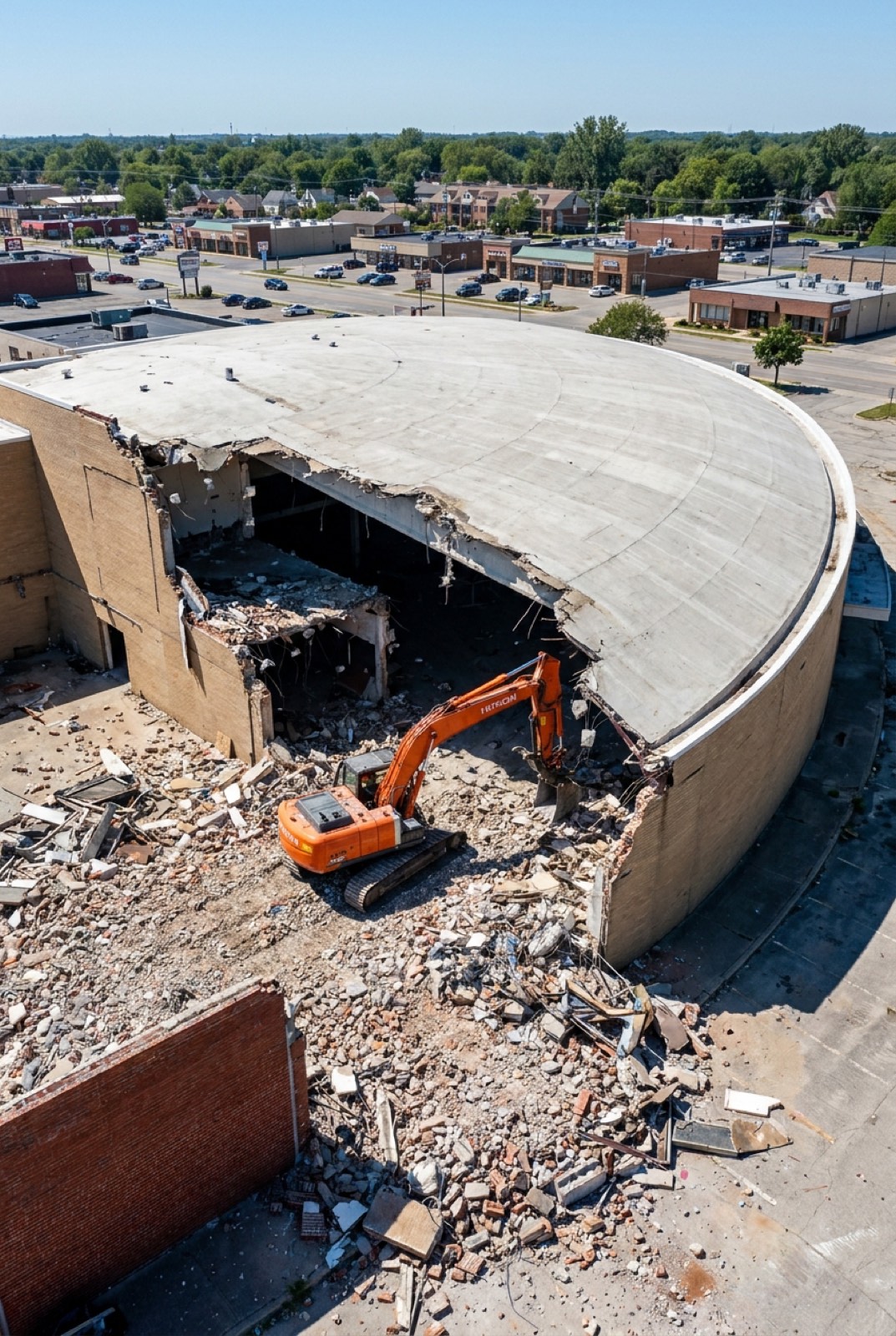
McLean Demolition holds a Class A DPOR contractor license — the highest classification issued by Virginia's Department of Professional and Occupational Regulation and the credential required for commercial demolition projects over $120,000 — and operates in full compliance with OSHA 29 CFR 1926 Subpart T on every commercial job site. We handle the complete project pipeline: ASHRAE 100 hazardous material survey coordination, DEMOC permit application to Fairfax County LDS, utility coordination with commercial Dominion Energy and Washington Gas accounts, selective or full mechanical demolition, and C&D sorting with licensed disposal documentation. Whether the scope is an office interior gut-out for a vacating tenant or a full commercial building teardown for redevelopment, the same licensed team manages every phase.
Commercial demolition services include: office interior gut-outs (2,000–5,000 sq ft, typically 3–5 business days), full commercial building teardown with DEMOC permit, retail strip demolition storefront-to-shell, light industrial and warehouse demolition, hazardous material survey coordination per ASHRAE 100, and construction and demolition debris removal with recycling documentation. We serve landlords, developers, property managers, tenants, and commercial general contractors throughout the McLean, Tysons, and Fairfax County market.
Office interior gut-outs for 2,000–5,000 sq ft spaces run $4,000–$25,000. Full commercial building demolition at 10,000 sq ft runs $50,000–$120,000. A hazardous material survey runs $1,500–$4,000 and is required by Fairfax County before any commercial mechanical demolition begins. Call (571) 506-2219 for a free commercial estimate.
Commercial demolition in Fairfax County involves DEMOC permits, ASHRAE 100 hazmat surveys, OSHA compliance documentation, and Class A licensing requirements that disqualify most residential-only contractors. McLean Demolition meets every commercial standard, manages every permit, and delivers on commercial construction timelines where delays cost money.
From tenant space gut-outs to full commercial building demolition, McLean Demolition provides permitted, OSHA-compliant commercial demolition services for landlords, developers, tenants, and general contractors throughout Northern Virginia.
Office interior gut-outs for 2,000–5,000 square foot tenant spaces in McLean and Tysons typically take three to five business days and run $4,000–$25,000 depending on square footage, ceiling system, floor finish, and the density of HVAC ductwork and plumbing fixtures. This scope is used when a tenant vacates and the landlord needs to return the space to shell condition for re-leasing, or when a new tenant's buildout requires a clean-slate interior.
A standard office gut-out removes non-structural partition walls, suspended ceiling systems, flooring, HVAC ductwork, plumbing fixtures, and electrical components down to rough structure. We maintain the structural shell, HVAC trunk lines (where specified), and the base building systems required by the new tenant's buildout. All debris is sorted and hauled with C&D recycling documentation provided. We schedule around building access requirements and coordinate with property management for freight elevator use and loading dock timing.
Full commercial building demolition in Fairfax County requires a DEMOC permit (the commercial equivalent of the residential DEMOR) from Fairfax County Land Development Services. Structures over 10,000 square feet require a pre-application meeting with LDS before the permit is issued. Before any mechanical demolition begins, an ASHRAE 100 hazardous material survey is required — this survey identifies asbestos-containing materials, lead paint, PCBs, and other regulated substances under AHERA protocols for commercial structures.
A 10,000 square foot commercial building typically takes one to two weeks for mechanical demolition and debris removal using our full-size excavator with hydraulic shear and grapple bucket attachments. We provide milestone schedules aligned to the developer's redevelopment timeline. Concrete, metal, and masonry are sorted and recycled as C&D material, with disposal documentation provided for the project environmental file. Site is graded to developer specifications after structure removal.
Retail strip demolition encompasses single-bay and multi-bay storefront removal, typically for repositioning or redevelopment of strip mall properties in Fairfax County. Per-bay costs run $5,000–$15,000 depending on bay size, construction type, shared wall conditions, and whether the demolition is selective (one or two bays in an occupied strip) or full-strip removal.
Selective bay demolition in an occupied strip requires careful attention to shared walls, utility isolation, and dust and noise control to protect adjacent tenants. We coordinate with property management and adjacent tenants before any work begins, establish temporary dust barriers at shared walls, and schedule work to minimize disruption to neighboring businesses. Storefronts are demolished to shell condition per landlord specifications, with framing, slab, and rough-in systems left in place or removed as scoped. All debris is hauled same-day where possible.
Light industrial demolition covers warehouse, flex-space, and distribution facilities in Fairfax County's industrial corridors. Per-square-foot rates for light industrial structures run $4–$10, reflecting the high material volume typical of concrete tilt-up and steel-frame construction. ASHRAE 100 hazmat survey is required before mechanical demo of any commercial structure regardless of construction type.
Tilt-up concrete panel demolition uses hydraulic shear and concrete pulverizer attachments to break panel sections efficiently without overloading trucks. Steel-frame structures are dismantled progressively from the top down per OSHA 29 CFR 1926.850, with structural steel separated for scrap recycling. Concrete floors and footings are broken with a hydraulic breaker, crushed on-site where practical, and hauled to a concrete recycling facility as C&D aggregate. We provide full OSHA compliance documentation and insurance certificates to the site general contractor.
Commercial demolition in Fairfax County requires Class A licensing, DEMOC permits, hazmat surveys, and OSHA documentation that standard residential contractors are not equipped to provide. These are the most common commercial situations we handle.
Every commercial demolition project in Fairfax County follows a four-phase sequence driven by county permit requirements, federal OSHA standards, and the hazardous material regulatory process applicable to commercial structures.
An ASHRAE 100 hazardous material survey is conducted by a certified industrial hygienist before any mechanical demolition begins. We then submit the DEMOC application to Fairfax County LDS — with pre-application meeting for structures over 10,000 sq ft. Permit fee runs $500–$2,500 depending on project scope.
We coordinate utility disconnections or isolations with commercial Dominion Energy, Washington Gas, and Fairfax Water accounts, as well as telecommunications providers. Commercial utility disconnection timelines differ from residential — we manage the scheduling to prevent project delays caused by utility availability windows.
Demolition proceeds in compliance with OSHA 29 CFR 1926.850 (Subpart T). Interior gut-outs use hand tools and skid steer for non-structural removal. Full building teardowns use hydraulic shear, grapple bucket, and concrete pulverizer attachments on our full-size excavator. Progressive demolition from top down is maintained throughout.
All construction and demolition debris is sorted on-site: concrete and masonry to recycling, structural steel to scrap, wood and gypsum to licensed C&D disposal. Hazardous materials are handled by licensed abatement contractors with proper waste manifests. Disposal documentation is provided for your project environmental compliance file.
The following price ranges reflect 2026 market rates for commercial demolition in the McLean, VA, Tysons, and Fairfax County area. All figures are project totals unless noted. Commercial projects are quoted after a site walk and scope review.
| Service | Price Range | Notes |
|---|---|---|
| Office Gut-Out — 2,000 sq ft | $4,000–$10,000 | Standard office space; partitions, ceiling, flooring, fixtures |
| Office Gut-Out — 5,000 sq ft | $10,000–$25,000 | Higher end if dense HVAC, plumbing, or specialty systems |
| Commercial Building — 10,000 sq ft | $50,000–$120,000 | Full building teardown with DEMOC permit and debris removal |
| Retail Strip per Bay | $5,000–$15,000 | Varies by bay size, shared wall complexity, tenant access |
| Light Industrial per Sq Ft | $4–$10/sq ft | Warehouse, flex-space, distribution; concrete tilt-up on high end |
| ASHRAE 100 Hazmat Survey | $1,500–$4,000 | Required before any commercial mechanical demolition |
| DEMOC Permit | $500–$2,500 | Fairfax County LDS; structures over 10,000 sq ft require pre-app meeting |
| Parking Structure (Partial) | Quoted separately | Post-tensioned concrete requires specialized engineering review |
The right commercial demolition scope depends on whether the building structure has remaining useful life or whether redevelopment requires starting from the ground up. Here is how the two approaches differ in practice.
Tysons Corner sits immediately adjacent to McLean along Route 7 and Route 123 and is one of Virginia's most active commercial redevelopment zones. Major corporate campuses, Class A office towers, and mixed-use developments have transformed Tysons from a suburban mall area into a high-density urban center anchored by the Silver Line Metro. This activity generates a steady volume of commercial demolition work: tenant gut-outs as offices turn over, building teardowns as older low-rise structures are replaced with higher-density redevelopment, and selective interior demolition as new tenants reposition existing spaces for their own programs. McLean Demolition serves this market with the commercial credentials and DEMOC permit experience that the Fairfax County commercial environment requires.
Commercial demolition in Fairfax County operates under the DEMOC (Commercial Demolition Permit) pathway — separate from the DEMOR used for residential structures. DEMOC applications are submitted through Fairfax County Land Development Services, and structures over 10,000 square feet require a pre-application meeting with LDS before the permit application is accepted. The permit fee runs $500–$2,500 depending on project scope. Before any mechanical demolition begins on a commercial structure, Virginia and Fairfax County require an ASHRAE 100 hazardous material survey conducted by a certified industrial hygienist. This survey identifies asbestos-containing materials (ACM), lead paint, polychlorinated biphenyls (PCBs), mercury, and other regulated substances under AHERA protocols. If regulated materials are found, licensed abatement must be completed before mechanical demo begins — the same regulatory framework as residential, but applied to the larger material volumes and more complex systems typical of commercial construction.
Virginia's DPOR Class A contractor license is the highest classification in the state and is required by law for commercial demolition and construction projects with a contract value over $120,000. Class B licenses are capped at $120,000 per project and $750,000 annual volume; Class C licenses are limited to $10,000 per project. The majority of meaningful commercial demolition work in Fairfax County — full building teardowns, major interior gut-outs in larger spaces, and light industrial demolition — falls above the Class B threshold. McLean Demolition holds a Class A license, and our license number is available for verification with the Virginia Department of Professional and Occupational Regulation.
OSHA 29 CFR 1926 Subpart T governs all demolition work on commercial job sites and requires a licensed contractor to conduct an engineering survey of the structure before demolition begins, assess load-bearing systems, identify utility services, and plan the demolition sequence to prevent premature structural collapse. Progressive demolition — working from the top down in a controlled sequence — is the standard method for multi-story commercial structures under OSHA Subpart T. McLean Demolition operates with OSHA 30-hour certified crew supervisors on commercial projects and maintains a documented demolition safety program available for review by commercial general contractors and institutional clients.
For property managers, landlords, and developers in the McLean and Tysons commercial market, having a single Class A contractor for interior gut-outs, hazmat survey coordination, and full building demolition eliminates the coordination overhead of managing multiple specialty subcontractors through overlapping scopes. McLean Demolition coordinates the hazmat survey, manages the DEMOC permit, handles utility isolation, completes the demolition, and removes all debris — delivering a clean, documented project that meets Fairfax County's commercial construction compliance standards.