McLean Demolition is McLean's Class A licensed concrete demolition and removal contractor, serving Fairfax County homeowners, builders, and property managers with diamond saw-cut concrete removal, rebar extraction, and C&D recycling on projects from single slabs to full driveway replacement.
We remove every type of concrete flatwork and structure: residential driveways, slab-on-grade foundations, garage floors, concrete patios, retaining walls, concrete steps and stoops, footings, and curbs. Our equipment includes excavators with hydraulic concrete pulverizer attachments for efficient breaking and rebar separation, diamond blade concrete saws for perimeter scoring and control joint cutting, and skid steer loaders for tight-access residential sites where a full excavator cannot maneuver.
Unreinforced concrete removal runs $2–$4 per square foot. Reinforced concrete with rebar runs $4–$6 per square foot. A typical driveway project costs $1,200–$4,500. Tight-access or urban sites can reach $6–$14 per square foot.
McLean Demolition removes concrete flatwork and structures across Fairfax County with diamond saw scoring, hydraulic breaking, rebar extraction, and C&D recycling coordination handled in-house. One crew from cut to clean site, with no subcontractors for core demo work.
From a standard residential driveway to reinforced foundation breaking, McLean Demolition provides the right equipment and method for every concrete removal project in the McLean area.
Typical project cost: $1,200–$4,500. Concrete driveways are the most common flatwork removal project in McLean and the surrounding Fairfax County market. Northern Virginia experiences 80–100 freeze-thaw cycles per year, and piedmont clay soils with poor drainage accelerate the frost heave that eventually cracks and displaces concrete flatwork. A typical 500 sq ft residential driveway costs $1,200–$2,500 to remove and haul. Larger driveways over 800 sq ft run $2,500–$4,500. We score the perimeter and any expansion joints with a diamond blade saw before breaking begins, which produces cleaner edges and reduces the risk of cracking beyond the intended removal area. All concrete is hauled for C&D recycling, not landfill disposal.
Typical cost: $2–$4/sq ft for unreinforced slabs. Slab-on-grade demolition covers garage floors, shop floors, patio slabs, and thin interior slabs that have not been reinforced with rebar or wire mesh. These slabs are broken with a hydraulic hammer attachment or a skid steer-mounted breaker, then loaded in sections for hauling. Thin residential slabs of 3.5–4 inches are typically completed quickly, with a 400–600 sq ft slab finished and hauled in a single day. The subgrade is left at the removal elevation, ready for new construction or site grading. Slab removal in conjunction with residential demolition or shed and garage removal is performed on the same mobilization to keep overall project costs lower.
Typical cost: $4–$6/sq ft for reinforced slabs. Reinforced concrete foundations, thick garage slabs, and structural flatwork with rebar require a different approach than thin unreinforced slabs. We use an excavator-mounted hydraulic concrete pulverizer that simultaneously breaks the concrete and exposes the rebar, making extraction faster and cleaner than a hydraulic hammer alone. Extracted rebar is sorted and sent to metal recycling, which partially offsets disposal costs. For basement foundation demolition associated with a full house teardown, breaking typically represents 1–2 days of work after the above-grade structure is removed. Foundation breaking is quoted separately when combined with a full residential demolition project.
Typical cost: $8–$14/sq ft for tiered structures. Concrete retaining walls and footings are among the most labor-intensive flatwork removal projects due to their vertical orientation, depth, and typically heavy reinforcement. Many McLean and Great Falls properties include tiered concrete retaining walls that were constructed in the 1970s and 1980s and have begun to fail from hydrostatic pressure behind them. We saw-cut control joints in the wall face, break sections with a hydraulic breaker, extract rebar, and haul all material for recycling. Backfilling and compaction after retaining wall removal requires careful attention to drainage to prevent the slope failure that led to wall installation in the first place.
When one concrete panel sits higher or lower than the adjacent panel by more than half an inch, the lip created is a tripping hazard and a liability. Differential settlement in Northern Virginia is most commonly caused by expansive piedmont clay soils that shrink and swell with moisture changes, or by subsurface voids left by decaying tree roots beneath the slab.
Surface scaling and spalling occur when freeze-thaw cycles penetrate the concrete surface and pop off the top layer. Once the surface aggregate is exposed, water intrusion accelerates and the deterioration spreads quickly. At this stage, an overlay is a temporary patch at best. Full removal and replacement with properly reinforced concrete at 4 inches on a compacted aggregate base is the permanent fix.
Northern Virginia's 80–100 annual freeze-thaw cycles create significant uplift pressure beneath poorly drained concrete flatwork. Tree roots growing under a driveway or patio eventually crack through the slab and lift sections unevenly. Once uplift has occurred, the void beneath the slab cannot be properly compacted without removing the concrete first.
New additions, pool excavations, foundation work, and garage construction all require the existing concrete to be fully removed so the subgrade can be properly prepared. Partial slab removal under new construction creates weak spots and voids that cause settlement problems later. We remove the full slab and leave the subgrade compacted and ready for your foundation contractor.
A properly installed concrete driveway in Northern Virginia lasts 25–30 years under normal freeze-thaw conditions. When crack repair costs begin to approach the cost of full replacement, removal and a new pour is the better long-term investment. A new driveway with a proper compacted aggregate base and control joints at 10-foot intervals will outlast patching on a failed slab every time.
Cracks under a quarter inch wide can be filled and sealed to prevent water infiltration. Cracks wider than a quarter inch indicate structural movement in the slab that cannot be corrected by surface treatment. At this stage, the integrity of the concrete panel is compromised, and removal is more cost-effective than continued repair investment.
Every concrete demolition project follows the same four-step sequence: precision saw cutting before any breaking begins, mechanical demolition, material sorting, and C&D recycling.
A diamond blade concrete saw scores the perimeter of the removal area and any control joints before any breaking equipment is brought in. This precision cut defines a clean edge at the removal boundary and prevents cracking from propagating into adjacent concrete that is being retained. On driveway replacements adjacent to a public street, we saw-cut the curb interface to protect the curb from damage.
An excavator-mounted hydraulic breaker or concrete pulverizer attachment breaks the scored slab into manageable sections for loading. The pulverizer is preferred for reinforced concrete because it simultaneously separates the rebar from the broken material, reducing manual extraction time. On tight-access residential sites, a skid steer loader with a breaker attachment reaches areas where a full excavator cannot maneuver without damaging landscaping or structures.
Extracted rebar is sorted and staged separately from the broken concrete for metal recycling routing. Concrete rubble is loaded into dump trucks on-site. Wire mesh and other embedded metal is pulled from the broken material and added to the metal recycling stream. Sorting materials by type on-site improves recycling yield and reduces the blended tipping fee at the disposal facility.
Broken concrete is hauled to a licensed C&D concrete recycling facility where it is crushed to VDOT-spec aggregate for use as road base, fill, and new concrete production. Recycling concrete is both more environmentally responsible and less expensive than landfill disposal, since recycling facilities charge lower tipping fees than standard C&D landfills. Rebar and metal go to a separate scrap metal recycler.
Prices reflect 2026 ranges for McLean and Fairfax County. Final pricing depends on concrete thickness, reinforcement, access, and project size. Call for a free on-site estimate.
| Service / Concrete Type | Price Range | Notes |
|---|---|---|
| Unreinforced Slab | $2–$4/sq ft | Thin slabs without rebar; patios, shop floors, footings |
| Reinforced Slab (rebar or mesh) | $4–$6/sq ft | Includes rebar extraction and metal recycling |
| Standard Driveway (500 sq ft) | $1,200–$2,500 | Typical single-car or narrow double driveway |
| Large Driveway (800+ sq ft) | $2,500–$4,500 | Wide double or triple-car driveway; circular drive |
| Retaining Wall | $8–$14/sq ft | Vertical face square footage; tiered walls on high end |
| Foundation Breaking | $4–$8/sq ft | Post-demo basement foundation; depth affects pricing |
| Tight Access (urban/constrained) | $6–$14/sq ft | Sites requiring hand-breaking or skid steer only; no excavator access |
| Concrete Recycling | Included | All concrete hauled to C&D recycling facility; reduces disposal cost vs. landfill |
Some homeowners consider an overlay or resurfacing instead of full removal. Here is when each approach makes sense for Northern Virginia driveways and slabs.
Northern Virginia is a difficult environment for concrete flatwork. The Washington DC metro area averages 80–100 freeze-thaw cycles per year, significantly more than warmer mid-Atlantic markets. Every freeze-thaw cycle expands water that has infiltrated cracks and joints, widening them incrementally until the structural integrity of the slab is compromised. Concrete flatwork installed in McLean and Fairfax County during the 1970s, 1980s, and early 1990s is now in the final phase of its serviceable life, and full removal and replacement is increasingly the practical choice over continued patching.
The piedmont clay soils that underlie most of McLean and the broader Fairfax County market amplify the freeze-thaw problem. These dense, expansive soils have high water retention capacity, which means they stay moist longer than sandy or loamy soils after rain and snowmelt. Saturated clay beneath a concrete slab provides the moisture that drives frost heave. Many McLean driveways installed without adequate aggregate base material or subbase drainage are sitting directly on moist clay, which accounts for the heaving and differential settlement commonly seen in this market.
Concrete flatwork removal in Fairfax County does not require a DEMOR (Residential Demolition) permit. This is one of the few demolition activities in the county that proceeds without a permit, which means project scheduling is straightforward and turnaround is fast. Most standard residential driveway removals in McLean are completed and hauled in a single day.
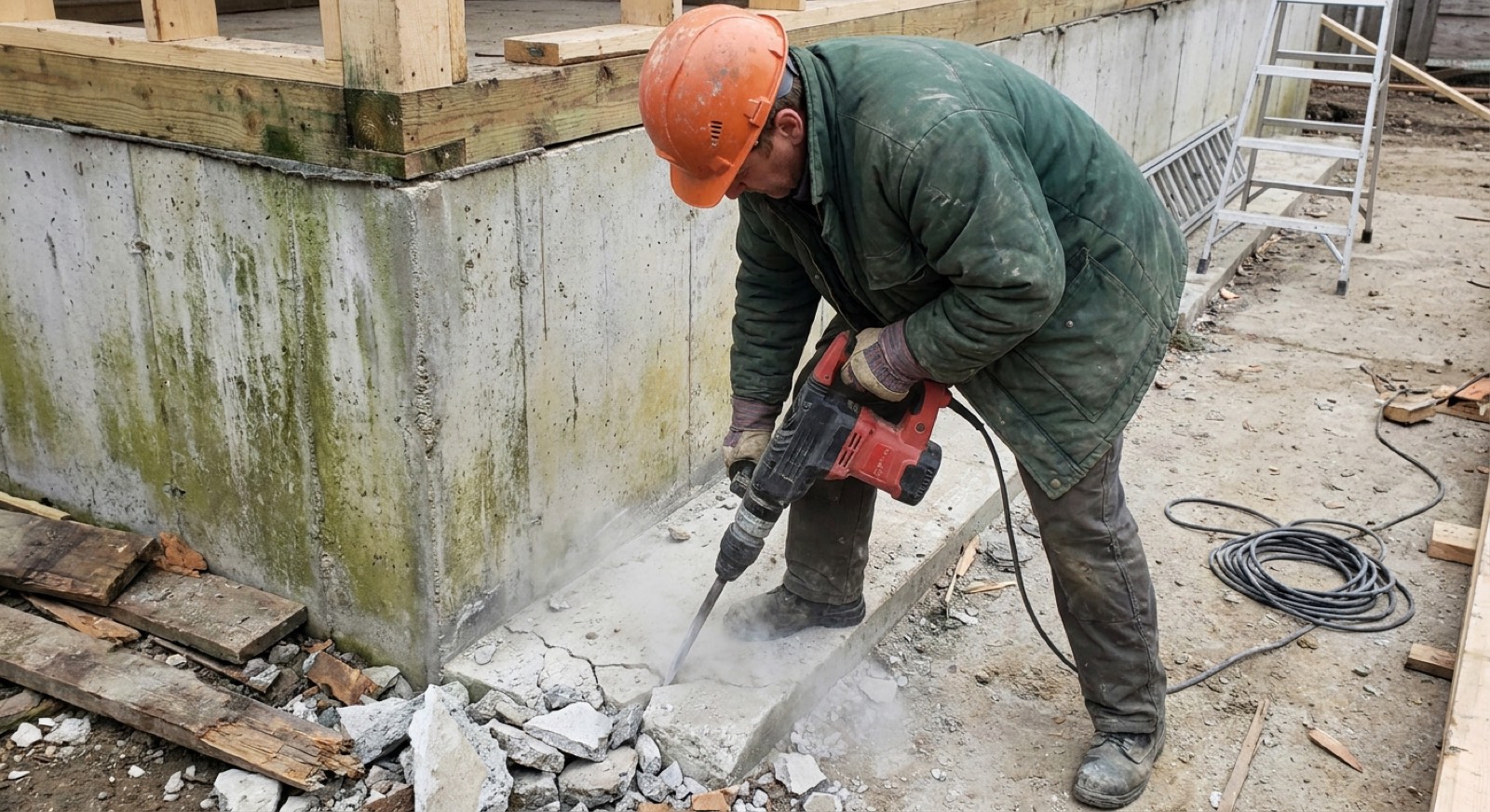
Concrete removed in Northern Virginia is recycled rather than landfilled. McLean Demolition hauls all broken concrete to licensed C&D concrete recycling facilities where it is crushed to VDOT-specification aggregate for use as road base and fill. This practice is both environmentally responsible and economically beneficial: recycling facilities charge lower tipping fees than C&D landfills, which keeps the overall cost of removal lower than it would otherwise be. The recycled aggregate produced from one average McLean driveway is sufficient for roughly 150 square feet of compacted road base.
McLean Demolition serves concrete removal projects throughout McLean, Great Falls, Fairfax, Vienna, Oakton, Springfield, and the broader Fairfax County market. We also serve commercial clients in Tysons, Arlington, and Alexandria where tight urban access requires a skid steer approach rather than a full-size excavator. The same diamond saw scoring, hydraulic breaking, rebar extraction, and C&D recycling process is used on every project regardless of size.
Every concrete removal project starts with a free on-site estimate where we measure the slab area, assess reinforcement, evaluate access, and confirm the scope. Call (571) 506-2219 to schedule your estimate in McLean, Fairfax County, or Northern Virginia.