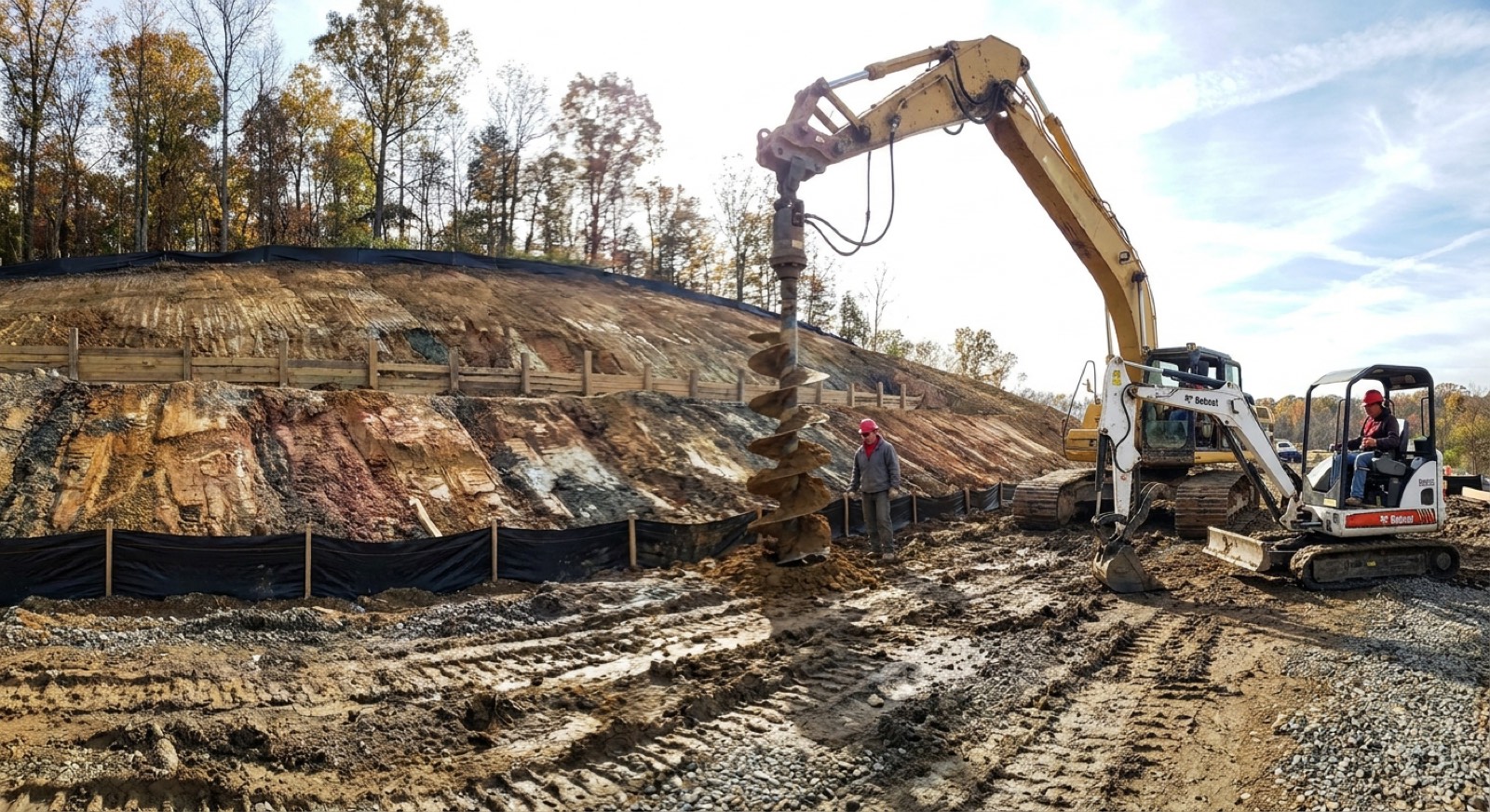
McLean Demolition provides complete site preparation and grading for residential and commercial projects throughout McLean, Fairfax County, and Northern Virginia. Typical residential lot preparation runs $1,300–$5,600. Custom home lot preparation, which includes clearing, grubbing, topsoil stripping, rough and fine grading, and compaction testing, typically runs $8,000–$20,000. Complex sites with significant grade change or drainage work can exceed $50,000.
Full site prep scope includes clearing and grubbing (tree and brush removal, root grinding), rough grading to establish design elevation using cut and fill, fine grading to shape drainage slopes, AASHTO T180 compaction testing at 95% of maximum dry density, ESC (erosion and sediment control) measures per Fairfax County LDS requirements, topsoil stripping and stockpiling for reuse, and subgrade preparation for the foundation contractor.
McLean Demolition's integrated demolition and site preparation service is a core advantage for teardown projects: we complete the residential demolition, debris removal, and site preparation under one contract with one crew, eliminating the scheduling gap and cost of bringing in a second contractor. Call (571) 506-2219 for a free on-site estimate for your site prep project.
Site preparation failures are invisible at first and catastrophic later. Improper compaction, inadequate drainage design, and skipped ESC measures in Northern Virginia's piedmont clay soils lead to foundation settlement, flooded basements, and regulatory stop-work orders. McLean Demolition delivers site prep to the standard that custom home builders and Fairfax County inspectors require.
Complete site preparation scope for new construction, additions, and lot improvement projects throughout Fairfax County and Northern Virginia.
Clearing and grubbing removes all trees, brush, stumps, and roots from the project area to prepare a clean surface for grading. Tree clearing in Northern Virginia costs $3,000–$4,800 per acre for average wooded lots and up to $6,155 per acre for heavily wooded terrain. We use a combination of chainsaw clearing for trees over 8 inches in diameter and a forestry mulching attachment for brush and understory growth. Stump grinding or full stump and root extraction is included in the clearing scope — buried root balls that are not removed become settling risks under future hardscape and foundations. All cleared material is processed on-site through the forestry mulcher where practical, reducing trucking volume, or hauled to a licensed C&D facility. Clearing work requires an ESC plan when it disturbs over 2,500 sq ft in Fairfax County, which McLean Demolition files as part of the project.
Rough grading establishes the design elevation across the lot using cut and fill operations: high areas are cut down and the material is moved to low areas to fill. The goal is to reach the benchmark elevation specified in the site plan within 0.1 foot of design grade across the entire footprint. Cut-and-fill grading is the most economical approach because it reuses on-site material rather than importing or exporting soil. When the site's cut and fill volumes do not balance, import fill material (borrow) is brought in or surplus spoils are hauled off-site. Rough grading in Northern Virginia's piedmont clay involves careful sequencing around weather, as clay becomes unworkable when saturated. McLean Demolition monitors weather conditions and can implement interim ESC measures to protect cut slopes during grading operations.
Fine grading follows rough grading and achieves the final surface configuration for drainage and foundation contractor layout. Fine grading typically runs $0.50–$1.50 per square foot. The goal is a positive drainage slope away from the foundation footprint on all sides, typically a minimum 2% slope (0.24 inches per foot) for the first 6 feet from the foundation wall per IEBC guidance. Fine grading also shapes swales, berms, and drainage channels that direct stormwater off the site without concentrating flow on adjacent properties. McLean Demolition uses GPS machine control on larger sites to achieve fine grading accuracy without manual staking, increasing speed and reducing re-grading passes. Topsoil stripped earlier in the project is respread over the final grade at 4–6 inches depth to provide a growing medium for the homeowner's landscaping installation.
AASHTO T180 compaction testing confirms that fill material placed during grading has reached 95% of theoretical maximum dry density before the foundation contractor mobilizes. Testing is performed by a licensed geotechnical technician at multiple depths and locations across the fill footprint. Test documentation is provided for the building department and retained in the project file. Without this documentation, many Fairfax County building inspectors will require re-testing before approving foundation work. ESC measures including silt fence, inlet protection, construction entrances, and slope stabilization are installed per the approved ESC plan and maintained throughout grading operations. ESC plans for sites disturbing over 2,500 sq ft are reviewed and approved by Fairfax County LDS before clearing and grading work begins.
McLean Demolition's four-step site preparation process delivers a certified subgrade ready for the foundation contractor in Fairfax County and Northern Virginia.
We review the site plan, confirm benchmark elevations, and prepare an ESC plan for submission to Fairfax County LDS for sites over 2,500 sq ft disturbed. Virginia 811 utility notification is completed before any clearing begins. The ESC plan review typically takes 5–10 business days. During this period, equipment staging and access routes are finalized.
Vegetation, trees, stumps, and root masses are cleared from the project area. Topsoil is stripped 6–8 inches deep and stockpiled on-site for reuse in final grading. Cleared woody material is processed through the forestry mulcher where practical or hauled to a C&D facility. ESC measures are installed as clearing proceeds to protect adjacent areas from sedimentation.
Cut and fill operations establish the rough design elevation across the lot, with surplus spoils hauled off or import fill brought in as needed to balance the site. Fine grading follows, shaping the surface to the final drainage configuration — positive slope away from the foundation on all sides, drainage swales where specified. Topsoil is respread at the final grade stage.
AASHTO T180 density testing is performed at multiple locations and depths across the fill footprint. Test results are documented and provided to the building department and foundation contractor. A final punch-list walkthrough is conducted with the foundation contractor or project manager to confirm elevation targets and access conditions. The site is ready for foundation layout and excavation.
Site preparation pricing varies significantly based on site conditions, grade change, clearing density, and import/export soil volume. The ranges below reflect current Fairfax County area pricing. Call (571) 506-2219 for a free on-site estimate.
| Service | Price Range | Notes |
|---|---|---|
| Standard Residential Lot | $1,300–$5,600 | Angi data for McLean area; basic grading and clearing |
| Custom Home Lot Preparation | $8,000–$20,000 | Full scope: clearing, grading, compaction, ESC |
| Complex Site — Significant Grade Change | $20,000–$50,000+ | Retaining walls, major cut-and-fill, rock, steep slopes |
| Clearing & Grubbing (per acre) | $3,000–$4,800 | Heavily wooded up to $6,155/acre; stumps included |
| Fine Grading (per sq ft) | $0.50–$1.50 | Final drainage shaping; topsoil respread included |
| Topsoil Stripping & Stockpile | $500–$1,500 | 6–8 inch strip; stored on-site for final grade reuse |
| ESC Plan & Permit | Included (structural scope) | Fairfax County LDS submission; required over 2,500 sq ft |
| AASHTO T180 Compaction Tests | Included (structural scope) | Documentation provided for foundation contractor and building dept. |
McLean teardown projects that go from demolition directly to new construction face a choice: hire one integrated contractor or coordinate a separate demolition company and a site prep contractor. Here is what the comparison looks like in practice.
McLean is the most active teardown market in Northern Virginia, with dozens of mid-century homes demolished each year and replaced with custom-built new construction ranging from 5,000 to 11,000 square feet. Every one of these projects requires site preparation between the demolition phase and the foundation contractor's arrival. McLean Demolition is positioned to serve both phases, providing continuous workflow from teardown through certified subgrade delivery.
Northern Virginia's piedmont province geology presents specific site preparation challenges that differ from coastal or mountain markets. The dominant soil type is piedmont clay, a dense, expansive material that shrinks and swells significantly with moisture changes throughout the year. This shrink-swell behavior, if not accounted for in the grading and compaction design, leads to differential settlement under foundations, slabs, and hardscape over time. McLean Demolition specifies engineered fill over native clay for structural fill applications and targets 95% of theoretical maximum dry density per AASHTO T180 to minimize post-construction movement.
Drainage is the other dominant site preparation concern on McLean properties. The area's topography features rolling terrain with localized high and low points that, if not addressed in grading, result in ponding around foundations and wet basement conditions. McLean Demolition's fine grading design ensures positive drainage away from the foundation on all sides, with swales and berms routing stormwater to the street, a storm inlet, or a bio-retention area as specified in the site plan. Proper drainage design at the grading phase costs far less than installing interior drainage systems after the home is built.
Fairfax County Land Development Services requires an Erosion and Sediment Control (ESC) plan for any grading activity that disturbs more than 2,500 square feet of land or occurs on slopes greater than 15%. Most McLean lot preparation projects exceed this threshold. The ESC plan specifies silt fence locations, construction entrances, inlet protection, and slope stabilization measures that must be installed before grading begins and maintained throughout the project. Failure to maintain ESC measures can result in Fairfax County stop-work orders and fines. McLean Demolition prepares the ESC plan, files it with LDS for review and approval, installs all required measures, and maintains them through project completion.
Custom home builders in McLean, Great Falls, and Oakton regularly work with McLean Demolition as their preferred teardown and site prep contractor. We understand the handoff requirements for foundation contractors — benchmark elevation confirmation, subgrade compaction documentation, utility trench coordination, and clean site access — and we deliver consistently so that foundation crews can mobilize immediately after our work is complete.
McLean Demolition serves McLean, Great Falls, Vienna, Oakton, Reston, Herndon, Falls Church, Fairfax, Arlington, Springfield, and all of Northern Virginia for site preparation and grading work. Call (571) 506-2219 to discuss your project. We provide free on-site estimates and can typically schedule a site visit within 24–48 hours.