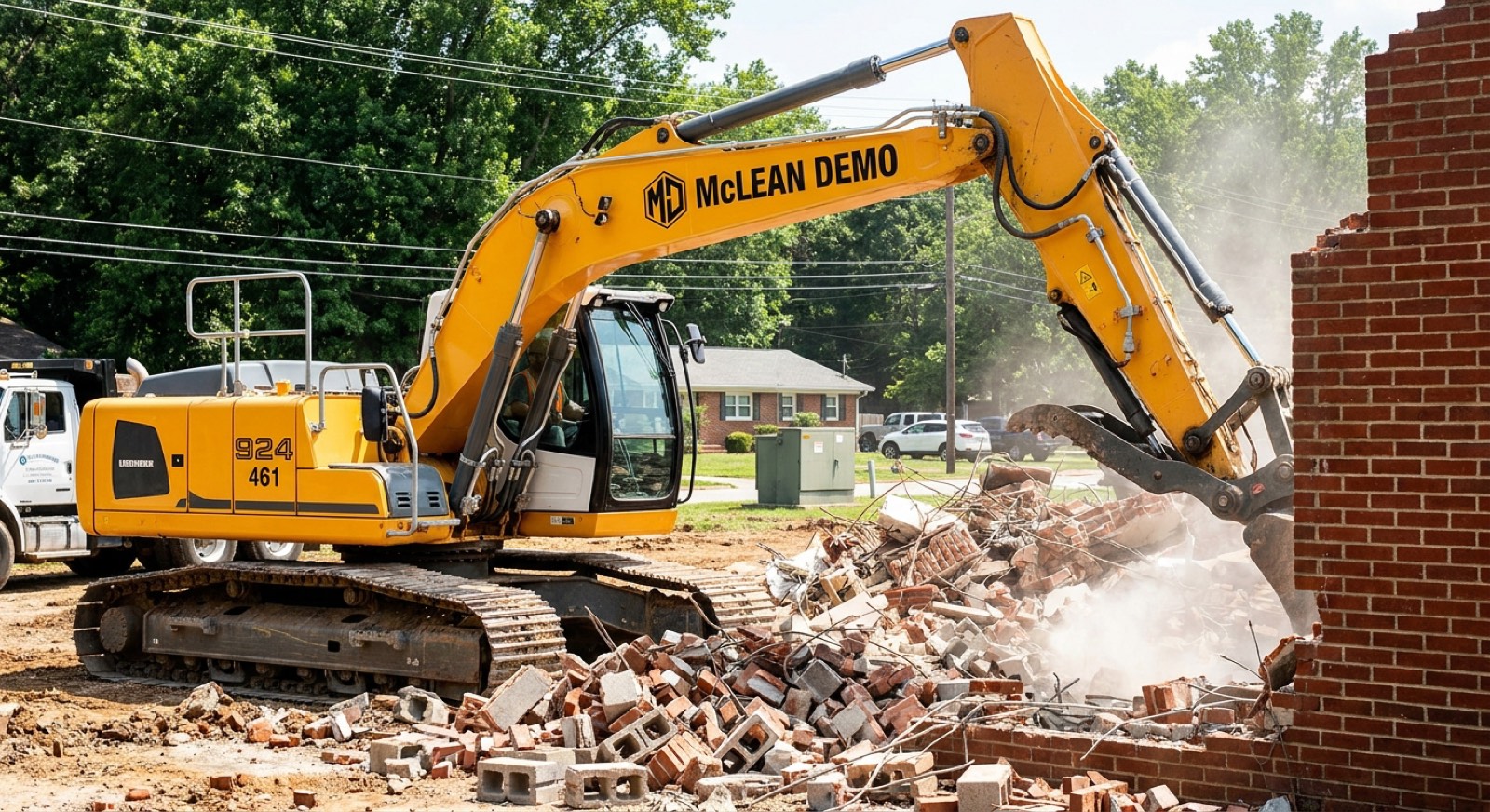
McLean Demolition handles complete house teardowns throughout McLean and Fairfax County, coordinating every step from DEMOR permit application through the Fairfax County PLUS system to final rough grading at new construction subgrade. We obtain written utility disconnection confirmations from Dominion Energy, Washington Gas, and Fairfax Water before any work begins, arrange asbestos inspections for pre-1980 structures, and manage licensed abatement when ACMs are found — all before the excavator arrives on site. The mechanical demolition itself takes one to three days on most McLean lots; the preparation work is where most of the timeline lives, and we manage it entirely.
Residential demolition services include: complete single-family home teardown, partial demolition and selective structure removal, foundation removal and basement excavation, post-demo rough grading to new construction subgrade, asbestos inspection coordination, sewer cap-off plumbing permit management, and all debris hauling to licensed C&D facilities. Whether your project is a lot-value teardown in McLean Hamlet or a fire-damaged structure in Chesterbrook, the same experienced team manages the full scope.
Full house demolition in Fairfax County runs $9,400–$19,800 for a standard single-family home. Homes under 4,000 sq ft without a basement typically fall in the lower range at $9,400–$11,900; adding basement removal costs $2,000–$5,000 more. The per-square-foot rate runs $4–$17 depending on construction type, material complexity, and site access. Call (571) 506-2219 for a free on-site estimate.
Fairfax County's permit process for residential demolition is more involved than most homeowners expect — and mistakes at the permit or asbestos stage can add weeks to a project timeline. McLean Demolition has navigated the DEMOR process, the Fairfax County PLUS system, and the asbestos inspection and abatement pipeline hundreds of times. We handle every step so you can focus on what comes next.
From complete lot-value teardowns to partial structure removal and post-demo site grading, McLean Demolition covers every phase of the residential demolition process in Northern Virginia.
Full residential demolition in Fairfax County runs $9,400–$19,800 for a standard single-family home, reflecting the permit coordination, asbestos inspection, utility confirmation, and mechanical demolition that a complete teardown requires. Homes under 4,000 square feet without a basement typically fall in the $9,400–$11,900 range; larger homes over 4,000 square feet with complex construction run $15,400–$19,800 and up.
Mechanical demolition using a full-size excavator typically takes one to three days on a standard McLean lot, depending on structure size and construction type. The permit coordination and utility confirmation process runs two to four weeks and is the primary timeline driver for most projects. We use progressive demolition techniques on two-story structures to maintain site safety throughout the mechanical phase, and all debris is hauled to licensed C&D facilities with no residual material left on site after grading.
Foundation removal and basement fill adds $2,000–$5,000 to the base demolition cost, depending on basement size, wall thickness, and the engineered fill volume needed to bring the lot back to grade. Many McLean lots targeted for custom new construction require full foundation removal so the new building's footprint can be positioned freely — keeping an old foundation in the ground limits the new builder's options for footprint, orientation, and setback.
The foundation is broken with a hydraulic pulverizer or concrete breaker attachment, then removed and hauled to a concrete recycling facility. The resulting void is backfilled with clean engineered fill in compacted lifts, with AASHTO T180 compaction testing at 95 percent maximum density — the same compaction documentation the new home's foundation contractor will require before pouring. Final rough grade is established at the new construction subgrade specified by the builder.
Pre-demolition asbestos inspection for pre-1980 structures costs $300–$600 and is conducted by a NVLAP-certified asbestos inspector who samples floor tiles, pipe insulation, joint compound, ceiling texture, roofing materials, and exterior siding. Virginia does not legally mandate inspection for residential demolition, but Fairfax County strongly recommends it, and most builders and lenders require it before issuing a DEMOR permit or financing a teardown project.
If ACMs are found, licensed abatement must be completed before mechanical demolition resumes under Virginia state law and Fairfax County code. Licensed abatement costs $1,200–$15,000 depending on ACM volume and material type. We coordinate the abatement contractor, file the miscellaneous abatement permit with Fairfax County LDS, and schedule clearance air testing before mechanical demo resumes. The full abatement process typically adds three to seven business days to the project timeline.
Post-demolition site grading establishes the rough grade at new construction subgrade, ready for the builder's site survey, foundation layout, and excavation. This phase runs $1,300–$5,600 depending on lot topography, debris volume, and how much cut-and-fill grading is needed to achieve a consistent subgrade across the building envelope.
AASHTO T180 compaction testing is performed after filling any basement void and after final grading in areas that will receive structural loads. Topsoil stripped during the process is stockpiled for redistribution around the future home's perimeter during finish grading. Erosion and sediment control measures are maintained throughout in compliance with Fairfax County ESC requirements. The site is handed over clean, graded, and documented — ready for your builder's crew.
Residential demolition is the right path in several specific situations where renovation no longer makes structural or financial sense. Here are the conditions we see most frequently in the McLean and Fairfax County market.
Every residential demolition in Fairfax County follows a four-phase sequence driven by the county's permit requirements, utility disconnection rules, and hazardous material regulations. The process is predictable when it is managed by a contractor who has done it hundreds of times.
We submit the DEMOR application through the Fairfax County PLUS system and coordinate written disconnection confirmations from Dominion Energy, Washington Gas, and Fairfax Water. We also file the sewer cap-off plumbing permit and schedule utility disconnections. This phase typically takes two to four weeks from application to permit issuance.
For pre-1980 structures, a NVLAP-certified inspector samples all suspect materials. If ACMs are found, we file the miscellaneous abatement permit, coordinate the licensed abatement crew, and schedule clearance air testing before mechanical work begins. This phase adds three to seven business days when abatement is required.
Our full-size excavator takes down the structure using progressive demolition techniques — working from the top down to control material fall, manage salvageable items separately, and keep the site safe throughout. Mechanical demolition of a standard McLean home typically takes one to three days, with debris loaded into trucks for same-day or next-day hauling.
The foundation is broken up and removed, the basement void is backfilled with compacted engineered fill, and the site is rough-graded to new construction subgrade. AASHTO T180 compaction testing is completed, and all remaining debris is hauled off site. The project is not complete until the site is clean and ready for your builder.
The following price ranges reflect 2026 market rates for residential demolition in Fairfax County and the McLean, VA area. All figures are project totals unless noted otherwise.
| Service | Price Range | Notes |
|---|---|---|
| Home Demolition — 1,000 sq ft | $5,000–$15,000 | Slab-on-grade or crawl space; permits included |
| Home Demolition — 2,000 sq ft | $10,000–$34,000 | Standard two-story colonial; typical McLean range |
| Home Demolition — 3,000 sq ft | $15,000–$50,000 | Larger structure; complexity and access-dependent |
| Basement Removal Add-On | +$2,000–$5,000 | Foundation removal and engineered fill backfill |
| Per Square Foot Rate | $4–$17/sq ft | Varies by construction type, material complexity, site access |
| ACM Inspection (Pre-1980) | $300–$600 | NVLAP-certified inspector; strongly recommended before DEMOR |
| Licensed Abatement if Required | $1,200–$15,000 | Depends on ACM volume and material type found |
| Post-Demo Site Grading | $1,300–$5,600 | Rough grade to new construction subgrade; AASHTO T180 included |
McLean homeowners and their builders often face a genuine decision between demolition and major renovation. Here are the factors that distinguish each path.
McLean, Virginia is one of the most active residential teardown markets in the country, and understanding why requires only one data point: the city's average home value reached approximately $2.2 million in 2026. In neighborhoods like The Langley, McLean Hamlet, Salona Village, Evans Mill, Chesterbrook, and along the Georgetown Pike corridor, the land beneath a mid-century ranch or split-level is often worth more than the structure sitting on it. Buyers regularly purchase these properties with full intent to demolish and commission custom new construction of 5,000 to 11,000 square feet or more. This teardown-and-rebuild dynamic is not unusual in McLean — it is the dominant pattern in several neighborhoods.
Fairfax County's DEMOR (Residential Demolition Permit) process is more involved than most homeowners anticipate, and managing it incorrectly adds weeks to a project timeline. The permit application is submitted through the Fairfax County PLUS online system administered by Land Development Services (LDS). Before the permit can be issued, the applicant must provide written confirmation from all three primary utilities — Dominion Energy for electric, Washington Gas for gas service, and Fairfax Water for water — confirming that each utility has been or will be disconnected. The utility companies need lead time to schedule disconnections, and coordinating three separate disconnection confirmations concurrently is where most permit delays originate. A separate plumbing permit is required for the sewer cap-off if the property is on public sewer, and a miscellaneous permit is required when asbestos abatement is needed.
Pre-1980 construction is abundant in McLean, where the mid-century building stock includes ranch homes, split-levels, and brick colonials that are prime teardown candidates for custom home builders. Most homes of that vintage contain asbestos-containing materials in some form — floor tiles, pipe insulation, joint compound, ceiling texture, roofing material, or exterior siding. Virginia does not legally mandate asbestos inspection for residential demolition, but Fairfax County strongly recommends it, and many lenders, builders, and insurers require it before a DEMOR permit is issued or financing is committed. A pre-demolition asbestos inspection costs $300–$600 and takes a certified inspector three to seven business days from sampling to written clearance report.
If ACMs are found — and in pre-1980 McLean homes, some ACMs are found in most inspections — licensed abatement must be completed before mechanical demolition begins under Virginia state law and Fairfax County code. McLean Demolition coordinates the abatement contractor, files the miscellaneous abatement permit with Fairfax County LDS, and schedules clearance air testing before the excavator mobilizes. Abatement typically adds three to seven business days to the project timeline and $1,200–$15,000 to the total cost depending on ACM volume.
Mechanical demolition itself is the fastest phase. A standard McLean home takes one to three days for the excavator to take down, with debris staged for immediate hauling. The foundation phase — breaking the perimeter foundation, removing the material, backfilling the basement void with compacted engineered fill, and rough-grading to new construction subgrade — typically takes another one to two days. For custom home builders active in McLean, having a single contractor manage every phase from DEMOR permit through final rough grade eliminates the overhead of coordinating separate demo, abatement, and excavation teams across a compressed project timeline.