GREAT FALLS, VA

Demolition Contractor Serving Great Falls, VA

McLean Demolition is a Class A DPOR-licensed demolition contractor serving Great Falls, Virginia with full estate teardowns, land clearing, pool removal, excavation, and site preparation for new custom home construction throughout Fairfax County. We handle every phase from initial permit filing through final grading, coordinating with Fairfax County LDS and working within the specific constraints of Great Falls estate properties along the Georgetown Pike corridor and surrounding neighborhoods.

Great Falls is one of the most distinctive demolition markets in Northern Virginia, defined by large estate lots where buyers regularly purchase 1960s and 1970s homes specifically for the land value, demolish the existing structure, and build 6,000 to 12,000 square foot custom homes in their place. Land values in Great Falls frequently exceed structure values, making teardown economics straightforward for lots exceeding one acre along Georgetown Pike, Walker Road, and neighboring streets, with active new custom construction underway in Langley Farms, Falls Farm, and Deerfield Farm at any given time.

McLean Demolition handles DEMOR permit coordination through the Fairfax County LDS PLUS portal for all Great Falls projects, navigates Great Falls Watershed overlay district requirements for properties near stream corridors, and provides erosion and sediment control plans required for wooded lot clearing. Call (571) 506-2219 for a free on-site estimate at your Great Falls property.

(571) 506-2219

Free Estimate in Great Falls, VA

Demolition Services in Great Falls, VA

McLean Demolition provides the full range of estate demolition, land clearing, pool removal, and excavation services throughout Great Falls and Fairfax County.

Residential Demolition in Great Falls

The estate teardown market in Great Falls is among the most active in Fairfax County, with buyers purchasing original 1960s and 1970s ranch homes, colonials, and split-levels on large wooded lots for their land value rather than the existing structure. McLean Demolition provides full structural demolition for single-family homes throughout Great Falls, including complete foundation removal, basement excavation for custom home construction, and site grading to finished elevation as specified by the incoming builder.

Older Great Falls estate homes frequently contain asbestos-containing materials including pipe insulation wrap, vermiculite attic insulation, and 9-inch by 9-inch vinyl floor tiles, all requiring pre-demolition hazmat assessments and licensed abatement on confirmed ACMs before structural work begins. We coordinate all DEMOR permit filings through the Fairfax County LDS PLUS portal and handle utility disconnections with NOVEC, Dominion Energy, and Washington Gas prior to any demolition activity.

Full house demolition in Great Falls runs $9,400 to $19,800 depending on structure size, foundation type, and site access conditions. Estate properties with larger structures and complex access along wooded private drives typically fall in the upper portion of this range.

Land Clearing in Great Falls

Great Falls is predominantly wooded, and virtually every estate teardown project requires significant land clearing before or during demolition work to create equipment access, establish building envelopes, and prepare lots for new custom home construction. McLean Demolition provides full land clearing services throughout Great Falls, including tree removal, stump grinding, brush clearing, and root raking on estate lots of all sizes along the Georgetown Pike corridor and surrounding communities.

Fairfax County requires erosion and sediment control plans approved before any land-disturbing activity affecting more than 2,500 square feet, which applies to virtually every Great Falls land clearing project. The Great Falls Watershed overlay district, covering properties near Difficult Run, Colvin Run, and other stream tributaries, imposes Resource Protection Area buffer requirements and stormwater management standards that affect clearing limits and equipment staging areas near protected stream corridors.

Land clearing in Great Falls typically runs $3,000 to $6,155 per acre depending on tree density, species mix, brush cover, and slope conditions. Heavily wooded lots with large-diameter hardwoods, dense understory growth, and steep terrain are common in Great Falls and require the heavy equipment needed to handle estate-scale clearing efficiently.

Pool Removal in Great Falls

Great Falls estate properties from the 1960s through the 1980s commonly include large inground pools constructed as original amenities. These pools frequently need full removal during teardown-rebuild projects, either because the new custom home design places the building footprint over the existing pool location or because incoming owners do not want to retain an aging pool with deteriorating concrete walls and outdated plumbing that no longer meets current code requirements.

McLean Demolition provides full pool removal in Great Falls starting at $7,000, including complete breakout of concrete walls and floor, removal of all steel reinforcement and plumbing, and backfilling with compacted clean fill material graded to match the surrounding lot. Pool fill-in services, where the structure is partially demolished and filled with compacted granular material, range from $2,000 to $10,000 depending on pool size and depth.

We coordinate the required Fairfax County demolition permit for pool removal and handle site grading and topsoil restoration after pool removal to leave a level, usable area ready for new landscaping or site development. Inground hot tub removal in Great Falls runs $400 to $1,100 when handled during pool removal or as a standalone service.

Excavation Services in Great Falls

Custom home construction in Great Falls requires significant excavation work for new foundations, basement systems, and utility trenching on lots that often feature complex topography, subsurface rock formations, and mature root systems from decades of established hardwood canopy. McLean Demolition provides full excavation services throughout Great Falls, including basement excavation, footing trench work, utility trenching, and site grading to builder-specified finished elevations on new construction lots.

Excavation rates in Great Falls run $240 to $420 per hour depending on equipment class and site conditions, with larger Caterpillar and Komatsu excavators required for deep basement systems and rock excavation where Piedmont granite or quartzite is encountered at shallow depths. Hydraulic hammer attachments are used for rock breaking when subsurface rock layers prohibit standard bucket excavation, eliminating the need for separate rock-breaking subcontractors on Great Falls new construction sites.

Site grading after excavation and demolition in Great Falls typically runs $1,300 to $5,600 depending on site size, cut and fill volume, and final grade complexity. McLean Demolition performs all grading work in-house as a single source for demolition, excavation, and site preparation, reducing project coordination complexity and mobilization costs for Great Falls custom home builders.

Great Falls Demolition Market: The Estate Teardown Economy

Great Falls, Virginia stands apart from every other Fairfax County community in terms of demolition economics. The community is almost entirely single-family estate properties with lot values ranging from $1.2 million to over $5 million, and the entry-level home in Great Falls regularly sells above $1 million even for structures dating to the 1960s that would require substantial renovation to meet modern expectations. Buyers in Langley Farms, Falls Farm, and Deerfield Farm routinely purchase these older structures not for the buildings themselves but for the land beneath them, with the clear intent to demolish and build 6,000 to 12,000 square foot custom homes in their place.

The Georgetown Pike corridor and adjacent Walker Road estate lots contain some of the most valuable residential land in all of Fairfax County, with winding private roads, heavily wooded setbacks, and equestrian properties providing the rural character that distinguishes Great Falls from every other Northern Virginia community. Equipment access is a specific challenge on these lots, as the same winding private roads and mature tree canopy that give properties their value also restrict the movement of demolition equipment to and from work areas, requiring careful planning for equipment staging, access routes, and tree protection during every project. McLean Demolition conducts access route surveys at the initial estimate visit to protect existing trees, fencing, and neighboring properties throughout all Great Falls project phases.

Great Falls Woods and Springvale represent established communities where renovation activity runs alongside teardown work, with homeowners who intend to stay in place modernizing original structures through kitchen gut-outs, bathroom overhauls, and basement renovations that require interior selective demolition services. The Riverside Manor parcels and neighboring estate properties along the Potomac watershed also include older inground pools and elaborate outdoor hardscaping from original estate construction that frequently requires removal during renovation or teardown projects. McLean Demolition serves the full range of Great Falls demolition projects from minor interior selective work to complete estate teardowns with land clearing for new custom home construction.

Demolition contractor in Great Falls, VA

How a Great Falls Demolition Project Works

McLean Demolition handles every step from permit to final grading. Here is what the process looks like for a typical Great Falls estate demolition project.

1

Free On-Site Estimate

We visit your Great Falls property within 24 to 48 hours of your call to assess the structure, site access, tree coverage, and any special conditions including watershed overlay proximity, equestrian fencing, or shared private driveways. Most Great Falls estate estimates take 45 to 60 minutes on site given the complexity of the properties. We provide a written quote covering all scope items including permits, utility coordination, hazmat assessment, demolition, land clearing, and debris haul-off.

2

Permit and Utility Coordination

We file the DEMOR permit through the Fairfax County LDS PLUS portal and coordinate utility disconnections with NOVEC, Dominion Energy, and Washington Gas. For properties near stream corridors within the Great Falls Watershed overlay district, we also coordinate with Fairfax County Water Resources for any required stormwater management approvals before land-disturbing activity begins. Permit approval in Fairfax County typically takes 2 to 4 weeks from complete application submission.

3

Pre-Demo Hazmat and E&S Setup

Before structural work begins we complete a hazardous materials assessment on all pre-1990 Great Falls structures and coordinate licensed abatement for confirmed ACMs, which are common in older estate homes as pipe insulation wrap, vermiculite attic insulation, and 9-inch by 9-inch vinyl floor tiles with black mastic adhesive. We also install required erosion and sediment controls including silt fence, inlet protection, and stabilized construction entrance per Fairfax County Public Facilities Manual requirements before any clearing or demolition begins.

4

Demolition, Clearing, and Grading

Our crew completes the structural demolition, performs land clearing for equipment access and building envelope establishment, hauls all debris to licensed Fairfax area disposal facilities, and grades the site to builder-specified finished elevations. Heavy Caterpillar and Komatsu excavator equipment handles estate-scale structures and difficult site conditions throughout Great Falls. Full teardown on a typical Great Falls estate home takes 3 to 7 days on site depending on structure size and site complexity.

Great Falls, VA Demolition Cost Guide

Prices below reflect typical Great Falls and Fairfax County market rates. Final cost depends on structure size, site conditions, permit fees, and material types. Call (571) 506-2219 for a free written estimate.

Service Scope Estimated Cost Notes
Residential Demolition Full estate teardown $9,400–$19,800 / $4–$17 per sq ft Fairfax County DEMOR permit required; larger Great Falls estates trend toward upper range
Land Clearing Trees, brush, stumps per acre $3,000–$6,155 per acre Fairfax County ESC plan required; Watershed overlay may restrict clearing near stream corridors
Pool Full Removal Break out, remove, backfill $7,000–$16,000 Fairfax County pool demo permit; compacted fill and grading to finished grade included
Pool Fill-In Partial demo, structural fill $2,000–$10,000 Drainage holes punched in pool floor; fill compacted in lifts per Fairfax County standards
Excavation Foundation, basement, utility trenching $240–$420 per hour Rock-breaking attachment additional when Piedmont rock encountered at depth on Great Falls lots
Site Grading Cut/fill, finish grade, topsoil $1,300–$5,600 Compaction testing included; topsoil restoration and seeding available after demo
Hot Tub Removal Above-ground or in-ground $150–$800 above-ground; $400–$1,100 in-ground Concrete surround removal additional at $2–$6 per sq ft
Asbestos Abatement ACM removal, pipe wrap, floor tile, vermiculite $5–$20 per sq ft; typical $1,200–$3,500 Licensed inspector required; common in pre-1985 Great Falls estate homes before demo
Debris Removal Haul-off to licensed facility $100–$800 per truckload Included in full demo contracts; available as standalone service for cleanout projects

Why Great Falls Homeowners Choose McLean Demolition

McLean Demolition brings Class A licensing, estate-scale equipment capacity, and 14 years of Northern Virginia demolition experience to every project in Great Falls and throughout Fairfax County.

  • Class A DPOR-licensed demolition contractor based in McLean, VA — five minutes from Great Falls via Georgetown Pike
  • DEMOR permit coordination through Fairfax County LDS PLUS, including Watershed overlay district compliance for stream corridor properties
  • Full hazardous materials assessment on all pre-1990 Great Falls estate homes before any demolition or clearing begins
  • Heavy excavator capability with Caterpillar, Komatsu, and Volvo equipment for estate-scale Great Falls demolition and excavation projects
  • 600+ completed projects across Fairfax County and Northern Virginia over 14 years in business
  • Erosion and sediment control plan preparation and installation included on all Great Falls land-disturbing projects
  • 5.0 Google rating from Great Falls homeowners, custom home builders, and Northern Virginia general contractors
Demolition contractor in Great Falls, VA

What Makes Demolition in Great Falls, VA Different

Great Falls presents a set of demolition conditions unlike any other Fairfax County community. The combination of large estate lots, dense hardwood canopy, high-value land, complex topography, and older structures with hazardous materials makes Great Falls one of the most technically demanding demolition markets in Northern Virginia, requiring a contractor who understands the full range of conditions on these properties.

Estate-Scale Equipment and Site Access Constraints

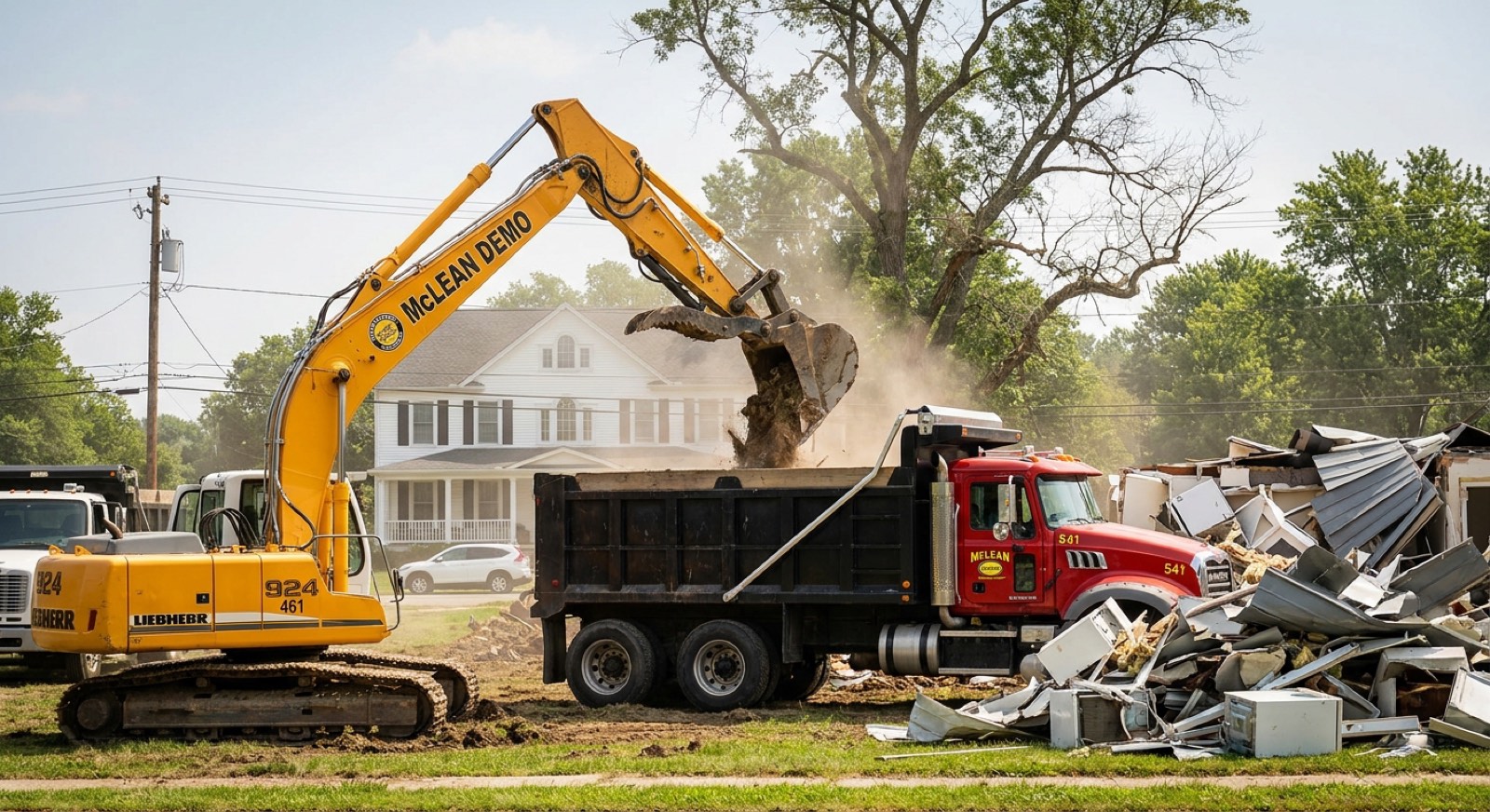
Great Falls estate lots require heavy demolition equipment including large crawler excavators in the 20 to 35-ton class to efficiently demolish the larger structures common in the area and clear wooded lots for custom home construction. The same winding private roads and dense tree canopy that define the character of Georgetown Pike and Walker Road estates create access constraints that require careful planning before equipment is mobilized. McLean Demolition conducts access route surveys at the initial estimate visit, identifying load limits on shared driveways, overhead clearance restrictions under mature trees, and any soft ground conditions near stream crossings that would require equipment matting for safe transit.

The broader equipment staging challenge on wooded Great Falls lots involves protecting trees that the client intends to retain after demolition while still providing adequate operating radius for excavator boom and stick reach during structural demolition and foundation removal. Tree protection fencing installed to the drip line of preserved trees must be in place before equipment mobilizes, and equipment operators must plan every work cycle to avoid encroaching on protection zones. McLean Demolition includes tree protection planning as a standard component of every Great Falls project estimate.

The Great Falls Watershed Overlay District

Great Falls properties near Difficult Run, Colvin Run, and other stream tributaries fall within Fairfax County's watershed overlay district regulations, which impose Resource Protection Area buffer requirements, impervious surface limits, and stormwater management standards that affect how demolition and land clearing work can be planned and executed near stream corridors. The Resource Protection Area buffer, typically 100 feet from the edge of perennial streams and tidal wetlands, prohibits land-disturbing activities without specific county approval under Chesapeake Bay Preservation Act provisions incorporated into Fairfax County code.

McLean Demolition identifies RPA boundaries at the initial site assessment using Fairfax County GIS parcel and environmental mapping data, coordinates with county staff on required approvals before any land-clearing activity begins near protected stream corridors, and designs ESC installations that prevent sediment from reaching stream buffers throughout the project. Many Great Falls properties sit well back from stream corridors and are not directly affected by the overlay restrictions, but properties near Difficult Run and Colvin Run tributaries require specific overlay analysis before clearing limits can be established.

Asbestos and Lead in Great Falls Estate Homes

The 1960s and 1970s construction that dominates the original Great Falls estate housing stock contains a range of hazardous materials that must be identified and abated before demolition work can proceed. Pipe insulation on older forced hot water heating systems commonly uses chrysotile asbestos wrapping at joints and elbows throughout mechanical rooms and service chases, while vermiculite attic insulation found in some estate homes may contain amphibole asbestos contamination from the Libby, Montana source material, which is treated as presumed positive without laboratory testing.

Asbestos cement floor tiles in the 9-inch by 9-inch format, along with the black mastic adhesive used to bond them to concrete substrates, are present throughout lower level and utility areas of these structures and remain hazardous even where covered over with newer flooring layers. Lead-based paint is essentially universal on pre-1978 construction throughout Great Falls, requiring lead assessment and appropriate containment protocols during any demolition activities where painted surfaces are disturbed. McLean Demolition requires pre-demolition hazmat assessments on all pre-1990 Great Falls structures and does not begin structural work until clearance is received from the licensed abatement contractor and inspector.

Erosion and Sediment Control on Wooded Great Falls Lots

Fairfax County's erosion and sediment control regulations under Article 4 of the Public Facilities Manual require approved E&S plans for all land-disturbing activities affecting more than 2,500 square feet of land area, which applies to every demolition and land clearing project in Great Falls. The combination of sloped terrain, dense root systems from mature hardwoods, and proximity to sensitive stream corridors makes proper E&S installation in Great Falls more demanding than on typical suburban lots elsewhere in Fairfax County.

McLean Demolition installs silt fence along lower clearing boundaries, inlet protection on any nearby storm drain structures, and stabilized construction entrances to prevent soil tracking onto Georgetown Pike and adjacent roads, maintaining all controls throughout the project until final stabilization is achieved. Post-demolition seeding, hydroseeding, or sod installation is coordinated with the incoming builder to ensure the site meets county stabilization requirements before the demolition permit can be closed out, protecting both the client and the surrounding watershed during the period between demolition completion and new construction commencement.
Serving Great Falls Neighborhoods and Communities

McLean Demolition works regularly throughout Great Falls and surrounding Fairfax County communities. Here are the neighborhoods where we most frequently complete estate teardowns, land clearing, pool removal, and excavation projects.

Demolition FAQs for Great Falls, VA

How much does residential demolition cost in Great Falls, VA?
Residential demolition in Great Falls typically runs $9,400 to $19,800 for a full estate teardown, or $4 to $17 per square foot depending on structure size, foundation type, and site access conditions. Great Falls estate homes from the 1960s and 1970s on larger lots with complex access along wooded private driveways tend to fall in the upper portion of that range. The price includes the Fairfax County DEMOR permit fee, all utility coordination with NOVEC and Dominion Energy, structural demolition, and debris haul-off to licensed disposal facilities. Call McLean Demolition at (571) 506-2219 for a free written estimate on your Great Falls property.
What permits are required for demolition in Great Falls, VA?
Great Falls is in unincorporated Fairfax County, so a DEMOR permit is required for any full residential demolition, processed through the Fairfax County LDS PLUS online permit portal. The application requires documentation of utility disconnections from NOVEC, Dominion Energy, and Washington Gas, plus a licensed contractor attestation and site plan showing the structure footprint. Properties near Difficult Run or Colvin Run stream corridors may also require coordination with Fairfax County Water Resources under the Watershed overlay district before land-clearing activity begins. McLean Demolition handles all DEMOR permit filings, utility coordination, and inspection scheduling without requiring homeowner involvement in the permit process.
Does my Great Falls estate home likely contain asbestos?
Great Falls estate homes built before 1985 have a high likelihood of containing asbestos-containing materials in multiple locations. Common ACMs include chrysotile pipe insulation wrap on forced hot water heating system lines, vermiculite attic insulation that may contain amphibole asbestos contamination, 9-inch by 9-inch vinyl floor tiles and black mastic adhesive, spray-applied ceiling texture, and asbestos cement roofing materials. McLean Demolition requires a licensed asbestos inspector's survey before any interior gut-out or full teardown on pre-1985 Great Falls structures. Abatement costs for a typical estate home in Great Falls range from $1,200 to $3,500 depending on the type and extent of confirmed ACMs identified during inspection.
What is the Great Falls Watershed overlay and how does it affect my project?
The Great Falls Watershed overlay district is a Fairfax County land-use regulation imposing buffer requirements and stormwater management standards on properties near Difficult Run, Colvin Run, and other stream tributaries in the area. Properties within 100 feet of perennial streams fall within the Resource Protection Area, where land-disturbing activities are restricted under Chesapeake Bay Preservation Act provisions in Fairfax County code. McLean Demolition identifies the RPA boundary using county GIS data at the initial site visit and coordinates any required county approvals before work begins near stream corridors. Most Great Falls properties set well back from stream corridors are not directly affected by the overlay restrictions, but we verify this at every initial site visit.
Do I need an erosion control plan for land clearing in Great Falls?
Yes. Fairfax County requires an approved erosion and sediment control plan before any land-disturbing activity affecting more than 2,500 square feet, which applies to nearly every Great Falls land clearing project. The plan identifies silt fence placement, inlet protection locations, stabilized construction entrance requirements, and tree protection zone boundaries. McLean Demolition prepares the required E&S plan as part of every Great Falls land clearing project, installs all required controls before clearing begins, and maintains those controls through project completion and site stabilization. The E&S plan is submitted to Fairfax County LDS along with the clearing permit application without a separate charge to the client.
How long does a Great Falls estate teardown take from start to finish?
The demolition and site preparation phase for a Great Falls estate teardown typically takes 4 to 6 weeks from initial permit application through completion of demolition, clearing, and site stabilization. The Fairfax County DEMOR permit process alone takes 2 to 4 weeks from complete application, with the actual structural demolition taking 3 to 7 days on site depending on structure size and site complexity. Pre-demolition asbestos abatement, if required, adds 3 to 10 business days depending on the scope of confirmed ACMs. After demolition, the incoming custom home builder can typically begin foundation work within 2 to 4 weeks of receiving the demolition completion certificate from the county inspector.

Ready to Start Your Great Falls Demolition Project?

McLean Demolition provides free on-site estimates for Great Falls homeowners and custom home builders throughout Fairfax County. One call gets you a licensed crew, full permit coordination, and a clean site ready for new construction.

(571) 506-2219